






Chapel Hill Tubal Reversal Center
109 Conner Drive Suite 2200, Chapel Hill, NC 27514 (919) 968-4656

Tubal Reversal Blog ‘tube’

Tubal Ligation Reversal After 40 | Pregnancy and Infertility

January 29th, 2009

Tubal ligation reversal is very successful at allowing women who have had their tubes tied to become pregnant again. In general, 70% of women who have their tubes untied at Chapel Hill Tubal Reversal Center become pregnant after  reversal of tubal ligation. This overall statistic is based on all patients, but there is variation depending upon an individual’s  age and method of tubal ligation.

Read the rest of this article and comment on it. »

Tubal Blockage Corrected by Tubal Surgery

December 13th, 2008

Tubal blockage or tubal occlusion (the medical term) is the reason that tubal ligation prevents pregnancy. The blockage of the fallopian tube prevents joining of the sperm and egg and prevents eggs from being able to reach the uterine cavity. In the case of tubal sterilization, tubal blockage is intentional. Tubal blockage may also occur due to disease conditions and result in involuntary infertility. Tubal blockage, whether intentional or from disease,  can be corrected with reconstructive tubal surgery.

Facts about Tubal Blockage

Tubal blockage affects millions of women in the US and hundreds of millions worldwide. More than 10 million women in the US, and more than 100 million worldwide, have had a tubal sterilization. There are approximately 6 million infertile couples in the US. It is estimated that 10-20% (600,000 to 1.2 million) cases of infertility may be due to tubal disease. In the majority of cases, tubal occlusion due to disease is caused by pelvic inflammatory disease (PID), an infection of the fallopian tubes (salpingitis) and sometimes the ovaries and pelvic cavity. PID is  “silent”, unrecognized, or misdiagnosed in many and perhaps in the majority of cases.

Read the rest of this article and comment on it. »

Week number two: A beautiful ligation reversal

August 4th, 2008

I started week number two at Chapel Hill Tubal Reversal Center with a beautiful ligation reversal.

Our patient was from North Carolina. She had a tubal ligation, which was done with bipolar cautery (burning) several years ago.

She went to her doctor to have her tubes tied, and after the surgery, her doctor told her, “The procedures I do are irreversible. You will never get pregnant again.” She told me she was fine with this at the time, but deep down she had feelings about why the doctor did such an aggressive procedure. She told me she thought to herself, what if she ever wanted to get pregnant again?

Well none of us can predict the future. As things so often go, she met a very special man who did not have any children. They married and together they desired a child. They came to us seeking to have her tubes untied.

I reviewed her operative note and things did not look good! Her operative note described cautery of the tube starting at the ampullary segment (the very end of the tube), and then cauterizing along the entire tube towards the side of the uterus. From the appearance of the operative note, it appeared most of the tube had been destroyed.

I recommended a screening laparoscopy to give us a quick evaluation before undergoing any surgical incisions. This would allow us to stop early if the tubes were not repairable. Unfortunately because of her Body Mass Index (BMI) issues, we were not able to proceed with a laparoscopy. Although we will perform tubal reversals for patients with BMIs up to 35, we do not perform laparoscopy for patients with a BMI over 30 due the possible increased risk of surgical complications.

This patient wanted a reversal and it was her personal decision to undergo a surgical incision so she could have an evaluation of her tubes.

As we started her surgery, we were uncertain if she would have repairable tubes. This was a wonderful patient who emanated a sense of enthusiasm and faith. She was someone you would characterize as having a beautiful personality. The entire surgical team was praying we would be able to help her.

As we started the incision, I was inwardly a little pessimistic that we would not be able to find any repairable tubes. I was afraid her doctor’s declaration about the nature of his tubal occlusions would be correct. I worried we would have to open her up, observe both her tubes having been obliterated and have to close her without doing her any good.

I was especially fearful of having to make the long surgeon’s walk. The long surgeon’s walk is the short, but measurable walk to the recovery/waiting room to give bad news to a patient’s family.

The worst thing for any tubal reversal surgeon is to have to tell a patient we could not repair their tubes. This is very comparable to a general surgeon having to tell a family their loved one did not make it through a risky surgery. To be honest, the two bad results are vastly different, but for a woman desiring tubal ligation reversal, it can feel very similar.

Things seem to happen for reasons. We found her to have good end segments and, as the operative note described, the tubes were cauterized to the very extreme side of the uterus. We were able to recover about 3cm of distal tube and found the remaining tubal lumens where they were hidden deep in the walls of the uterus. Isthmic-ampullary tubotubal anastamosis (tubal ligation reversal) was done on both sides and the average length of both tubes was about 3cm.

They ended up being short tubes. But short tubes are theoretically better than no tubes or closed tubes. We do have patients report pregnancies with tubal lengths much shorter than these.  We cannot create tubes. We can only work with what we find. Pregnancy for this patient is now very, very possible and prior to her reversal surgery, a natural pregnancy was impossible.

After the surgery, the entire team was thrilled. We never want to disappoint any patient, and we were able to give this woman both of her tubes back.

Dr. Berger and I were both very happy for this patient. We will be even happier when she reports a sticky bean to us (that’s a pregnancy for those who are not savvy to our Message Board lingo)!

Unexpected Finding During Tubal Ligation Reversal

July 10th, 2008

We periodically write case reports on patients who undergo tubal ligation reversal at Chapel Hill Tubal Reversal Center. The patient we will profile today had a ligation reversal procedure at our center last month.

She and her husband traveled to Chapel Hill from West Virginia. She is 34 years old and previously was an in-vitro fertilization (IVF) nurse. She is the mother of two children (ages 5 and 2). Her husband works as an engineer and is the father of both of their children. She had a tubal ligation after her second child because of two difficult, high-risk pregnancies.

Her first pregnancy was a vaginal birth complicated by heavy post-partum bleeding. Her heavy bleeding required a dilation and curettage (D and C) and emergency abdominal surgery to control the blood loss. She was diagnosed as having a placenta accreta. This is a condition where the placenta has invaded into the uterus too deeply and does not separate normally from the uterus at the time of delivery. She recovered from this surgery and eventually had a second pregnancy. This child was delivered by C-section and she had a Pomeroy tubal ligation done during the C-section. The operative report described tying and cutting the tubes as well as burning the ends. The pathology report described 1.5 cm tubal segments as being removed.

She explained to us, “My decision to have a tubal ligation was not done prayerfully but was more of a medically made decision.” She and her husband now desire more children in their life, and they traveled to Chapel Hill Tubal Reversal Center to have her tubal ligation reversed.

We were concerned that her doctor described in the operative report the tubal cauterization (burning) after tying and cutting the tubes. Since the mention of the cauterization was vague (we had no idea if a small segment was burned or the entire tube was burned) we discussed starting with a screening laparoscopy. Our patient was able to talk to her doctor who performed the tubal ligation. The doctor assured her only the ends of the tubes were burned. Since this can be a common practice and seemed minimal, the decision was made to proceed with ligation reversal without starting with a screening laparoscopy.

Microsurgical salpingostomy During her operation we found the right fallopian tube was abnormal. The right tube was long and healthy appearing, but there was no fimbriated end of the tube. This area is one of the most critical areas of the tube. The fimbriated ends act like millions of small fingers, which pick up the egg and direct the egg down the tube. The repair of this tube would require a more difficult microsurgical salpingostomy and creation of a ‘neo-fimbriated’ end of tube.

A microsurgical salpingosotomy was performed on her right tube. The left side was more normal- we had two tubal segments that we repaired with the usual anastomosis procedure. The entire operation was about one hour and fifteen minutes.

The story of this patient illustrates several important concepts:

1. She was a knowledgeable medical professional. She understood what it meant to have a tubal ligation. Many patients of all walks of life will have changes of heart as their lives change. Even medical professionals will make health care decisions for themselves, which later turn out to not be right for them. None of us can predict the future.

2. She was an IVF nurse and was aware of the pros and cons of tubal ligation reversal vs IVF. She and her husband decided ligation reversal was a more appropriate path for them.

3. Operative and pathology reports provide helpful information in planning for tubal repair, but they can sometimes be misleading.

4. The right tube was very difficult to repair. Often we will question ourselves as to whether a difficult tube should be repaired or should we just focus on the ‘better’ tube. We can never predict with 100% certain what will or will not work to help get a patient pregnant, so we like to give all patients the benefit of the doubt and try at all costs to open all the tubes we operate on.

We wish her and her husband a successful outcome of her tubal reversal operation and hope their prayerful decision will be soon rewarded.

Submitted by Dr. Charles Monteith

Tubal Reversal By Tubal Implantation

December 3rd, 2007

Tubal Reversal Procedures

There are 3 types of tubal reversal procedures:

  • anastomosis
  • implantation – (this blog topic)
  • salpingostomy

Implantation of Fallopian Tubes

Implantation of the fallopian tube is inserting the tube through a new opening into the uterus. Tubouterine implantation is correct medical terminology, but it is also called tubal implantation, uterotubal implantation, or uterine implantation.

Most tubal ligation operations leave two fallopian tube segments that can be reconnected. In some cases, only one tubal segment remains that is separated from the uterus and the portion of the tube within the uterine muscle is blocked as well. This is most likely to occur when a tubal ligation has been performed by monopolar tubal coagulation applied to the tubal segment next to the uterus. In this situation, tubal implantation is required as the tubal reversal procedure.

How I Perform Tubal Implantation

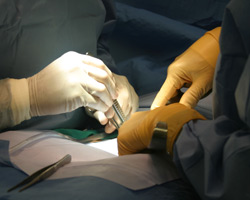
Dr. Berger performs tubal implantation by making an incision in the uterine muscle and introducing the tube into the uterine cavity.Tubal implantation is performed by making an incision through the uterine muscle. The incision is carried down into the uterine cavity. The tubal segment that has been separated from the uterus is opened and passed down until its proximal end is inside the uterine cavity. Before implanting the tube in the uterus, a suture is placed through the open end that goes inside the uterus. This suture is used to anchor the fallopian tube within the uterine cavity.

The fallopian tube is sutured in the uterine cavity and the uterine incision is sewn together around the implanted tube.When the tube has been anchored inside the uterine cavity, sutures are placed in the uterine muscle around the implanted tube. Care must be taken to close the uterine incision sufficiently to allow healing, but not so tightly that it compresses or constricts the implanted tube. Tubal implantation is a more difficult operation to perform than tubal anastomosis. Tubal implantation accounts for 1% of tubal reversal procedures at Chapel Hill Tubal Reversal Center.

More information on » tube

Special Report

Answers to seven important questions to find out if tubal reversal is right for you.

Telephone 919 968-4656 to speak with a Tubal Ligation Reversal Nurse

Call a Tubal Reversal Nurse
for a free consultation -

(919) 968-4656

Pregnancy Announcements | Latest Additions | FAQs | Press | MD News | Mission Statement | Privacy Policy | Doctors Directory | Site Map


http://www.tubal-reversal.net/includes/footer.php  was last modified on November 1st, 2009 18:15:35

Chapel Hill Tubal Reversal Center.
109 Conner Drive Suite 2200, Chapel Hill, NC 27514
Tel: (919) 968-4656     Fax: (919) 869-1976