







Chapel Hill Tubal Reversal Center
109 Conner Drive Suite 2200, Chapel Hill, NC 27514 (919) 968-4656

Tubal Reversal Blog ‘tubes untied’

Post Tubal Ligation Syndrome | A Long Journey

Monday, September 29th, 2008

Post tubal ligation syndrome journey.

Some women will develop problems after a tubal ligation procedure. Many will attribute these symptoms to Post Tubal Ligation Syndrome (PTLS) and will consider sterilization reversal. Some of these women will not have PTLS but, instead will have other underlying  medical conditions.

We started this series of articles for women suffering from adverse symptoms developed after a tubal ligation. We discussed the symptoms of Post Tubal Ligation Syndrome (PTLS), current medical studies about PTLS, and common medical conditions that can closely mimic PTLS. Like a long bus ride, we have expected most passengers to have exited this bus trip at each of their respective and appropriate stops after a thorough evaluation of the possible causes of their symptoms. If passengers are still riding, then the only stop left is PTLS.

In the past, the existence of PTLS has been widely debated but not agreed upon in various medical studies. The largest study to date, the CREST study, found no significant difference in the percentage of women with menstrual problems after a tubal ligation with a “control” group of women who did not have a tubal ligation. The authors of the CREST study concluded that adverse symptoms do not ocurr as a  result of tubal ligation. This study, however, was not designed to study the multitude of symptoms that women report after surgical sterilization.

The end of the journey

Our experience at Chapel Hill Tubal Reversal Center suggests PTLS does exist for a select group of women for whom no contributing medical, psychological, or other causes have been identified. Among this group of women, the vast majority have reported dramatic improvement in their symptoms after a reversal of their tubal ligation.

We will report the stories of several of our patients (both before and after tubal ligation reversal) who have had worsening physical and psychological conditions after sterilization and who have come to us seeking tubal ligation reversal. They will share with us their symptoms and how they have fared after tubal ligation reversal (had their tubes untied).

This is the sixth article in our 14 part series on PTLS and associated medical conditions. Our next several articles will present patients who have suffered from worsening menstrual, physical, and emotional symptoms after surgical sterilization procedures (women who had their tubes tied).

Visitors may join the PTLS Forum on the Tubal Reversal Message Board to share their experiences of symptoms after tubal ligation procedures and what happened to them after a tubal reversal.

Guilt or Regret about Tubes Tied…

Tuesday, September 23rd, 2008

Is it PTLS or another medical or gynecologic problem?

The symptoms of Post Tubal Ligation Syndrome (PTLS) can be widespread and pervasive. Women who have problems after a tubal ligation, however, may not have PTLS. Another medical or gynecological condition may be at the root of the symptoms. The prior article in this series on PTLS reviewed medical and gynecologic disorders that may cause menstrual problems after a tubal ligation.

Over 7,000 tubal ligation reversals have been performed at Chapel Hill Tubal Reversal Center. We have had the opportunity to see the impact on these women whose tubes have been tied and who, having regretted that decision, have had their tubes untied.

Under what circumstances were the tubes tied?

Often, the decision to have a one’s tubes tied is made under stressful circumstances. Sometimes the decision to have the tubes untied is made under similar circumstances. The staff of Chapel Hill Tubal Reversal Center has compiled a list of stressful reasons women have had tubal ligations or have come to us seeking ligation reversal. Stressful circumstances under which patients sometimes have a sterilization procedure or a sterilization reversal include:

• Forced by parent or spouse
• Pressured by doctor
• Frightened by medical conditions or illness
• Mid-life crises
• Empty nest syndrome
• Infidelity
• Divorce
• Death of spouse
• Fear of birth control risks
• Decision while in poverty
• Decision during period of substance abuse
• Illness/death of close family member
• Sterilization while in an abusive relationship
• Death of a child
• Religious conversion

Regret and guilt can be powerful forces on any individual. Given the appropriate stressful circumstances these feelings can be amplified and can spread into other aspects of ones life. When decisions are made under stressful conditions, as listed above, one can easily see how this may leave a lasting sense of remorse upon any individual. The sense of remorse can be even more dramatic when the thought is suppressed and eventually emerges in the future during a stressful life event. Then consider the sense of regret and how these feeling could be increased as a person grows older and wiser when a person finds their ‘life’s match’ or if their pastor tells them they ‘violated the will of God’ by having their ‘tubes tied’.

How common is regret after tubal sterilization?

Most women do not regret their decision to have a tubal ligation. However, 1 out of 4 women will regret their decision about having their tubes tied. This was shown in the CREST Study mentioned in a previous article.

Offering Hope at Chapel Hill Tubal Reversal Center

The tubal ligation reversal experts at Chapel Hill Tubal Reversal Center help women in reversing these ‘permanent’ decisions when they are no longer the right decisions for individuals and couples. We have helped many patients come by restoring the hope of new life and the chance for some to relieve their burdens of guilt and regret.

This is article 4 of a 14 part series on PTLS and associated medical conditions. The article, Psychological Conditions or Post Tubal Ligation Syndrome?, will address common psychological conditions that could be masquerading as Post Tubal Ligation Syndrome.

We invite readers to join the Tubal Reversal Message Board to discuss and share personal experiences with tubal ligation. We also invite women with post tubal ligation symptoms to join the PTLS Forum and share personal experiences with worsening physical or mental symptoms noticed after tubal ligation.

Success of Reversing Tied Tubes by Dr. Monteith

Thursday, September 18th, 2008

We are interrupting our 14 part Post Tubal Ligation Syndrome (PTLS) blog series to announce the first reported Monteith tubal reversal pregnancies and the arrival of the Monteith Miracle Tubal Reversal baby shirts!

Dr. Monteith’s Success at Reversing Tied Tubes

Dr. Monteith with Tubal Reversal Nurses at Chapel Hill Tubal Reversal Center.

Dr. Charles Monteith started working full time as a tubal reversal specialist on July 21st 2008 at Chapel Hill Tubal Reversal Center. We have received four pregnancy reports from patients during his first two weeks of reversing tied tubes.  His tubal reversal pregnancies have started to roll in!

The First Pregnancies

These four patients are representative of the patient population Chapel Hill Tubal Reversal Center and they come from all across the United States. They have had different types of tubal ligations and tubal lengths measuring from 3 to 8.5 cms.

Alaska (Falope ring tubal ligation)
New York (Bipolar cautery)
North Carolina (Bipolar cautery)
Idaho (Filshie clip tubal ligation)

And The Winner Is…

There has been an unofficial competition among patients of our Tubal Reversal Message Board for who would be the first patient to report a Monteith tubal reversal pregnancy. A patient from Alaska was the first to report a positive pregnancy test. She has confirmed that a first trimester ultrasound showed the pregnancy is in the uterus and is doing well. We have asked her to share her story and experience with us in a future blog article and she has said she will do this once her life calms down and her morning sickness disappears.

Why Have Pregnancies Been Reported So Soon?

These pregnancies have all occurred within the first two weeks of his reversing tied tubes. We typically ask our patients to wait a month until they try to conceive. So these patients likely started to attempt to conceive mid to end of August. They obviously had success and conceived at their first ovulation after ligation reversal!

To the patients of Dr. Monteith who have not yet conceived: keep up the faith and it should happen in due time. Most people do not realize how long it may take to become pregnant until they actually try. It can sometimes take up to 10-12 months before a successful conception can occur.

Monteith Miracle Tubal Reversal Baby Shirts

The Monteith Miracle Shirts have just arrived and are hot off the presses. They are ready to be sent out when the babies are delivered. All you have to do to receive one is:

Be a patient of Chapel Hill Tubal Reversal Center.
Be a tubal reversal patient of Dr. Montieth.
Become pregnant after tubal reversal.
Report the pregnancy to us.
Report the birth to us.

The first shirt goes out April of 2009 and the rest shortly thereafter. We wish these women good luck and all of the women who have had tubal ligation reversals by the tubal reversal doctors at Chapel Hill Tubal Reversal Center.

Diagnosing Menstrual Problems After a Tubal Ligation

Monday, September 15th, 2008

The origin of post tubal ligation symptoms can be confusing.Has your body gone ‘haywire’ after having your ‘tubes tied’? Many women report a variety of changes occurring after a tubal ligation. There are various gynecologic conditions that may be the cause and deserve proper evaluation by your doctor.

Problems that can occur after a tubal ligation

Previously, we introduced the topic of Post Tubal Ligation Syndrome (PTLS) as a suspected cause of problems that can occur after a tubal ligation. Women who experience problems after a tubal ligation may not have PTLS. If women have problems after a tubal ligation they commonly have two complaints: changes in their periods (menstrual pattern) and/or more painful periods. If you have had a tubal ligation and are experiencing these complaints, you could be suffering from an undiagnosed medical condition.

To determine if you have an underlying medical condition causing the above symptoms, it is helpful to be aware of the medical terminology for menstrual disorders.

Medical terminology

The medical terminology for changes in the frequency or amount of bleeding with your periods are:

• Oligomenorrhea
• Hypomenorrhea
• Hypermenorrhea (menorraghia)

Menstrual periods that are infrequent or irregular is termed oligmenorrhea. Periods that are scanty in amount of bleeding is called hypmenorrhea. Periods that are heavier in the amount of bleeding is termed hypermenorrhea or menorraghia (both terms refer to heavier periods).

The medical terminology for painful periods is dysmenorrhea.

Dysmenorrhea is divided into two categories:

• Primary (since puberty)
• Secondary (developed as you became older)

More painful periods developing after a tubal ligation would be categorized as secondary dysmenorrhea.

Medical causes of menstrual disorders

There can be many medical causes for oligomenorrhea, hypomenorrhea, or hypermenorrhea:

Uterine fibroids
Endometrial polyps
Adenomyosis
Uterine infections
Thyroid abnormalities
Endometrial hyperplasia
Endometrial cancer
Blood abnormalities (platelet disorders)
Ovulation disorders?
Polycystic Ovarian Syndrome?
Pregnancy*
Anorexia nervosa*
Congenital adrenal hyperplasia*
Perimenopause?
Pituitary abnormalities?

* Marked items are mostly associated with oligomenorrhea
? Marked items can be associated with both oligo and hypermenorrhea

Most women who develop abnormalities in their menstrual cycle after a tubal ligation will not have a serious medical condition. Most will have hormonal abnormalities, uterine fibroids, or anovualtion as the cause for changes in their menstrual cycle. These are common conditions that occur as a person either ages or experiences significant changes in weight.

Dysmenorrhea

There can be many medical causes for dysmenorrhea. These are the major causes of secondary dysmenorrhea:

Gynecologic disorders
Endometriosis
Adenomyosis
Ovarian cysts
Pelvic adhesions
Pelvic inflammatory disease
Uterine polyps
Congenital obstructive Müllerian malformations
Cervical stenosis
Nongynecologic disorders
Inflammatory bowel disease
Irritable bowel syndrome
Uteropelvic junction obstruction
Psychogenic disorders

Secondary dysmenorrhea can be experienced by many women. The most common causes are endometriosis, adenomyosis, and ovarian cysts. Causes of secondary dysmenorrhea can sometimes be difficult to identify. Sometimes, women may need to be referred to other medical specialists to diagnose the cause of secondary dysmenorrhea.

Changes in one’s menstrual cycle are common and can also occur after a tubal ligation procedure. When a woman has a tubal ligation and then develops any of the symptoms discussed above, it is tempting to attribute them to Post Tubal ligation Syndrome; however, there may be other underlying medical or gynecological conditions responsible for these changes.

The tubal ligation reversal experts at Chapel Hill Tubal Reversal Center recommend you see your medical provider if you develop any of the above symptoms after a tubal ligation. The purpose of your visit will be to diagnose any medical conditions which could the cause of your symptoms. If your doctor is unable to determine any medical explanation or if your symptoms are more extensive than those listed above, the doctor might attribute your symptoms to depression, anxiety, post traumatic stress disorder, or regret over your prior decision to have a surgical sterilization.

PTLS Articles on the Tubal Reversal Blog

This is article 3 of a 14 part series about Post Tubal Ligation Syndrome, being published twice a week. Our next article will be entitled Guilt or Regret after Tubal Sterilization.

We invite readers to join the Tubal Reversal Message Board and discuss and share personal experiences with tubal ligation. We also would like patients to join our PTLS Forum and share their personal experiences with worsening physical or mental symptoms noticed after tubal ligation.

Comment by Dr. Berger

The terms introduced in this article - such as oligomenorrhea, hypomenorrhea, hypermenorrhea, and dysmenorrhea - are descriptive medical terms for common menstrual disorders. When they occur, they deserve a thorough medical evaluation. As Dr. Monteith has described, there are many underlying causes or diagnoses for these conditions.

The question that seems to be at issue regarding Post Tubal Ligation Syndrome is this: when symptoms develop after a tubal ligation, are they attributable to the tubal ligation itself or to some other underlying condition? If no other underlying causes are found, then is PTLS the diagnosis remaining by exclusion? If a doctor does not believe in the existence of PTLS and no underlying medical or gynecologic diagnosis is evident, is attributing the symptoms to depression, anxiety, post traumatic stress disorder, or sterilization regret reasonable, accurate, or sufficient?

Articles About Post Tubal Ligation Syndrome

Pain After Tubes Tied: A Symptom of Post Tubal Ligation Syndrome?

Monday, September 8th, 2008

Women come from all over the world to Chapel Hill Tubal Reversal Center for reversing tied tubes – or more correctly put in medical terms, to have a tubal anastomosis. The majority of our patients desire sterilization reversal so they may naturally conceive more children. Many others, however, have ligation reversals to feel more complete again and/or to alleviate symptoms that have occurred after their surgical sterilization procedure. These patients report new physical and psychological symptoms after undergoing tubal ligation - symptoms that have been described as Post Tubal Ligation Syndrome (PTLS).

Symptoms of Post Tubal Ligation Syndrome

There are many symptoms attributable to PTLS. The most predominant symptoms are:

• Menstrual pattern changes
• Painful periods
• Hot flashes
• Irritability
• Mood swings
• Insomnia
• Decreased sex drive
• Anxiety
• Depression
• Memory changes

Does PTLS really exist?

The existence of Post Tubal Ligation Syndrome has been very controversial within the medical community. Early medical studies suggested that some sterilized women (women who had their tubes tied) had abrupt changes in bodily symptoms after their surgical procedures. These physical and mental changes were called Post Tubal Ligation Syndrome.

PTLS has been widely talked about by both women and medical professionals. Currently, PTLS information, advice, and ‘expert’ commentary saturate the internet. Conspiracy theories are prominent. Some people even believe sterilization is being forced upon women and there is a conspiracy, or lack of serious medical counseling, regarding the symptoms of PTLS.

More recent medical research has demonstrated that women do have changes in their menstrual patterns after tubal ligation; however, these changes are not as dramatic or as widespread as have been suggested in the past.

Observations from the Tubal Reversal Center

The tubal ligation reversal experts at Chapel Hill Tubal Reversal Center provide sterilization reversal to a large number of women from across the world. We also counsel and treat a substantial number of women who attribute their worsening menstrual patterns to their tubal ligation procedures. These patients report a multitude of PTLS symptoms.

We like for our patients to be well-informed. Since women seeking relief of PTLS represent an increasing percentage of the patient population we care for, we would like to dedicate a series of informative blog articles discussing the concept of PTLS. More specifically, we would like to discuss the common medical reasons for new symptoms noticed after tubal ligation, current understanding about PTLS, and common psychological conditions which can mimic PTLS.

This is article 1 of a 14 part series. Our next article in this series - Post Tubal Ligation Syndrome: Past and Present - will be published shortly.

We invite readers to join the Tubal Reversal Message Board to discuss and share their personal experiences with tubal ligation. Feel free to contribute to our PTLS forum dedicated to patients who have personal insight into worsening symptoms after undergoing tubal ligation.

Editorial Comment

The decision to add a series of articles about Post Tubal Ligation Syndrome on the Tubal Reversal Blog was prompted by requests and suggestions of many of our tubal reversal patients. Most doctors have been taught that no such entity as PTLS exists, much to the exasperation of women who are suffering from symptoms that began after a tubal sterilization. This series of blog articles will allow individuals to report about their personal experiences and case histories. Then, articles from the medical literature will be reviewed and discussed. Hopefully, this approach will help explain the discrepancy between what individual women have experienced and what medical doctors think about this complex subject. I encourage both patients and medical professionals to contribute their insights and opinions to this important series of articles.

Gary S. Berger, MD
Medical Director
Chapel Hill Tubal Reversal Center

Challenging Tubal Ligation Reversal: Uchida Tubal Ligation

Friday, August 29th, 2008

Tubal Reversal Experts

The tubal ligation reversal experts of Chapel Hill Tubal Reversal Center are experienced at sterilization reversal. Many women who have had their ‘tubes tied’ will come to our center to have their ‘tubes untied’. Unfortunately, a ligation reversal is not as easy as ‘untying’ the tubes- we wish the process was that simple.

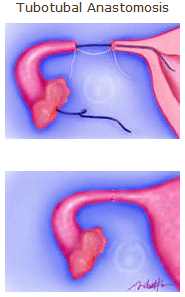
We employ a microsurgical approach to repair and reattach the ends of the tubes. This process is called tubotubal anastamosis, and provides a patient with an excellent chance of becoming pregnant naturally. We specialize in ligation reversal and in reversal of difficult tubal ligation procedures.
We would like to present the story of one of our patients who had an atypical sterilization procedure.

Reversal of an Unusual Sterilization Procedure

The patient’s name is Ofralinda. She and her husband, Juan, came to us from Texas. Ofralinda is 35 and she works as an OSHA compliance officer. Her husband is in construction. Ofralinda desired a tubal ligation reversal in order to have more children. She had a rare and atypical sterilization procedure termed the Uchida procedure.

Uchida Sterilization Procedure

A Japanese physician, Dr. Uchida, first described this method of sterilization in 1961. This method involves removing a large segment of the fallopian tube and suturing (sewing) the cut end of the fallopian tube into the wall of the uterus. Dr. Uchida first published information about his method of sterilization after having performed over 50,000 procedures without any pregnancy failures. This is an effective but also  complicated method of surgical sterilization. Most modern physicians have never performed or seen a Uchida sterilization. We have seen several patients who have presented with a Uchida sterilization procedure and we have had success with reversal of this method.

Uchida Sterilization Reversal

Ofralinda had a 60-minute outpatient tubal ligation reversal. Her surgery went well. We found her tubes to be short (due to the large amount of tube removed with her initial Uchida sterilization) but otherwise healthy. We were able to successfully repair both of her fallopian tubes. She has since been discharged back to her home and we wish her well. We would like to hear a report of a successful pregnancy from her within the year.

Sterilization Reversal at Chapel Hill Tubal Reversal Center

We specialize in tubal ligation reversal. Our tubal ligation reversal specialists perform over 800 reversal procedures every year on women from across the world. We regularly have patients from as far away as Hawaii, Alaska, and the Caribbean. Occasionally, we will have patients from Australia, Asia, and Europe.

Most tubal ligation procedures are reversible. The pregnancy rates after reversal are generally higher than after in vitro fertilization (IVF) and we specialize in difficult tubal reversal procedures.

Week number two: A beautiful ligation reversal

Monday, August 4th, 2008

I started week number two at Chapel Hill Tubal Reversal Center with a beautiful ligation reversal.

Our patient was from North Carolina. She had a tubal ligation, which was done with bipolar cautery (burning) several years ago.

She went to her doctor to have her tubes tied, and after the surgery, her doctor told her, “The procedures I do are irreversible. You will never get pregnant again.” She told me she was fine with this at the time, but deep down she had feelings about why the doctor did such an aggressive procedure. She told me she thought to herself, what if she ever wanted to get pregnant again?

Well none of us can predict the future. As things so often go, she met a very special man who did not have any children. They married and together they desired a child. They came to us seeking to have her tubes untied.

I reviewed her operative note and things did not look good! Her operative note described cautery of the tube starting at the ampullary segment (the very end of the tube), and then cauterizing along the entire tube towards the side of the uterus. From the appearance of the operative note, it appeared most of the tube had been destroyed.

I recommended a screening laparoscopy to give us a quick evaluation before undergoing any surgical incisions. This would allow us to stop early if the tubes were not repairable. Unfortunately because of her Body Mass Index (BMI) issues, we were not able to proceed with a laparoscopy. Although we will perform tubal reversals for patients with BMIs up to 35, we do not perform laparoscopy for patients with a BMI over 30 due the possible increased risk of surgical complications.

This patient wanted a reversal and it was her personal decision to undergo a surgical incision so she could have an evaluation of her tubes.

As we started her surgery, we were uncertain if she would have repairable tubes. This was a wonderful patient who emanated a sense of enthusiasm and faith. She was someone you would characterize as having a beautiful personality. The entire surgical team was praying we would be able to help her.

As we started the incision, I was inwardly a little pessimistic that we would not be able to find any repairable tubes. I was afraid her doctor’s declaration about the nature of his tubal occlusions would be correct. I worried we would have to open her up, observe both her tubes having been obliterated and have to close her without doing her any good.

I was especially fearful of having to make the long surgeon’s walk. The long surgeon’s walk is the short, but measurable walk to the recovery/waiting room to give bad news to a patient’s family.

The worst thing for any tubal reversal surgeon is to have to tell a patient we could not repair their tubes. This is very comparable to a general surgeon having to tell a family their loved one did not make it through a risky surgery. To be honest, the two bad results are vastly different, but for a woman desiring tubal ligation reversal, it can feel very similar.

Things seem to happen for reasons. We found her to have good end segments and, as the operative note described, the tubes were cauterized to the very extreme side of the uterus. We were able to recover about 3cm of distal tube and found the remaining tubal lumens where they were hidden deep in the walls of the uterus. Isthmic-ampullary tubotubal anastamosis (tubal ligation reversal) was done on both sides and the average length of both tubes was about 3cm.

They ended up being short tubes. But short tubes are theoretically better than no tubes or closed tubes. We do have patients report pregnancies with tubal lengths much shorter than these.  We cannot create tubes. We can only work with what we find. Pregnancy for this patient is now very, very possible and prior to her reversal surgery, a natural pregnancy was impossible.

After the surgery, the entire team was thrilled. We never want to disappoint any patient, and we were able to give this woman both of her tubes back.

Dr. Berger and I were both very happy for this patient. We will be even happier when she reports a sticky bean to us (that’s a pregnancy for those who are not savvy to our Message Board lingo)!

Why Women Get Tied Tubes Untied

Saturday, June 21st, 2008

Over a year ago, I approached Dr. Berger at Chapel Hill Tubal Reversal Center to start a new career as a tubal ligation reversal specialist. When I started to pursue my interest and training in tubal reversal surgery, I naively thought that only women who wanted to have another child had their tied tubes untied. I have come to realize that some women seek to have their tubes untied for many reasons other than to have another child after tubal ligation.

Of course the number one reason is to have more children, but there are many more and equally important reasons patients give. Some common reasons patients come for tubal ligation reversal are to:

  • relieve symptoms associated with a tubal ligation (PTLS)
  • feel whole again
  • be like God intended them to be
  • comply with their religious tenants
  • feel more like a woman
  • relieve regret of a prior mistake
  • correct a decision made during a bad relationship
  • fill the emptiness from the loss of a child or another loved one

As a generalist ob/gyn, I was always keenly aware of how many women bore both the burden of having children and the burden of sterilization. It was only after I became a ligation reversal specialist I saw how heavy the burden of tubal ligation could be. Now I have the opportunity to help in these situations and feel gratified that my training as a tubal reversal surgeon is progressing nicely under Dr. Berger’s mentorship.

Submitted by Dr. Charles Monteith
Tubal Reversal Specialist in Training
Chapel Hill Tubal Reversal Center

Doctors’ Attitudes About Tubal Ligation Reversal

Thursday, June 12th, 2008

Many women who have had a tubal ligation find themselves considering tubal ligation reversal. We have patients who come to Chapel Hill Tubal Reversal Center from all areas of the United States, Europe and Asia for ligation reversal procedures. They come to have their tubes untied for a variety of reasons. Many patients have told us about the frustration they felt when talking to their ob/gyn doctors about tubal ligation reversal or to a reproductive specialist who recommended only in-vitro fertilization (IVF). Many patients have also said their doctors minimize their concerns about symptoms they developed after having their tubes tied.

We recently published a blog about why some doctors may have negative opinions regarding ligation reversal surgery: Why your doctor may be cold to the idea of tubal ligation reversal. We also went to our message board and asked our patients and prospective patients about personal experiences with their physicians when talking about ligation reversal surgery. There we found out that many doctors were very supportive of their patient’s desire to have reversal surgery. The responses can be read under the message board topic: Share your doctors’ attitudes about tubal ligation reversal. Please feel free to leave your story about your experience when seeking reversal surgery or your doctor’s attitude toward the surgery. To leave comments on the Tubal Reversal Doctors Blog, please register and then log in (right hand column). Alternatively, you can add posts to the message board topics shown above.

At Chapel Hill Tubal Reversal Center, we are committed to providing you with the information you want to know about. That’s why the Chapel Hill Tubal Reversal team welcome your ideas, questions and comments. Whether you’re wondering about tubal reversal pregnancy rates, PTLS or how to talk to your doctor about having your tubes untied, we want to be able to address your concerns about tubal ligation reversal.

Submitted by Dr. Charles Monteith
DrMonteith@tubal-reversal.net

A Patient at Chapel Hill Tubal Reversal Center

Wednesday, May 21st, 2008

As my training as a Tubal Reversal Specialist continues, I would like to share the story of one of our recent patients.

This patient lives in Pennsylvania. She came to Chapel Hill Tubal Reversal Center for a ligation reversal and her story is similar to many of the women who come here to have their tubes untied.

She is 32 and had two older teenage children. She had her tubes tied after her second child. Unfortunately, her husband died after her tubal ligation, but she eventually found a new partner who did not have any children. She and her partner eventually decided they wanted a child together. They had researched the possibility of having another child and made an appointment with an infertility specialist in Pennsylvania. She considered in-vitro fertilization (IVF); however, she and her infertility specialist decided the better option for her would be tubal ligation reversal. Her infertility specialist recommended Dr. Berger as the tubal reversal expert who could give her the best tubal reversal procedure so she and her partner could pursue their desire of having more children.

When the patient came to Chapel Hill Tubal Reversal Center for her pre-operative visit, her partner was unable to travel with her for the reversal surgery; however, she did bring a close friend. We reviewed her medical history. Her tubal ligation surgery was performed many years ago and there were no operative or pathology reports available. She was able to get some information from her ob/gyn doctor who told her she had the ’standard type of tubal ligation’. She told us about her history and her dreams of having more children.

I was happy that she had excellent operative results and a successful bilateral ligation reversal. She stayed overnight at the local Sheraton Hotel where she was seen in the morning by one of the Chapel Hill Tubal Reversal Nurses. Following the postoperative check-up, she returned to her home in Pennsylvania to pursue her quest for adding more children to her family. We are eager to hear from her as soon as she has a positive pregnancy test!

Submitted by Dr. Charles Monteith
Chapel Hill Tubal Reversal Center

More information on » tubes untied
Pregnancy Announcements | Daily News | Latest Additions | Press | Privacy Policy | MD News | Mission Statement | Site Map | Español
Website updated October 6th, 2008 Chapel Hill Tubal Reversal Center© Chapel Hill Tubal Reversal Center
109 Conner Drive Suite 2200, Chapel Hill, NC 27514 (919) 968-4656
   Tubal Reversal News

http://www.tubal-reversal.net/includes/footer.php  was last modified on September 7th, 2008 21:16:23

109 Conner Drive Suite 2200, Chapel Hill, NC 27514 (919) 968-4656