








Chapel Hill Tubal Reversal Center
109 Conner Drive Suite 2200, Chapel Hill, NC 27514 (919) 968-4656

Posts Tagged ‘tubouterine implantation’

Ethics of Tubal Ligation

Wednesday, December 26th, 2007

Tubal Sterilization For Young Women With No Children

One of today’s patients at Chapel Hill Surgical Center was a woman in her thirties who recently become married and had a tubal ligation at age 24 years when she had no children. Her tubal ligation had been performed by a tubal coagulation procedure in which the fallopian tubes were burned at the junction of her uterus. The tubal lumen or opening within the uterine wall was scarred completely on both the right and left sides from the burning procedure. Therefore, the only way to perform a tubal reversal was through the technique of tubouterine implantation.

I mention this case because it was unnecessarily destructive, especially when performed for a young woman with no children. Many studies show that these are women who are most likely to change their minds later on and want to be able to have children. In this case, almost any other tubal ligation procedure would have been preferable. In my view, the best choice of a tubal ligation for a young woman with no children is the clip method (either Hulka clip or Filshie clip).

I have encountered other cases like this in the past. I wonder if the doctor who performed her tubal ligation considered the possibility that the patient might change her mind, and therefore it would be preferable to perform a tubal ligation better suited to reversing at a later time, should the need arise.

Comments Welcome

I am interested in what other people think about this.

Unusual Tubal Abnormalities at Tubal Reversal Surgery

Monday, December 17th, 2007

Salpingitis Isthmica Nodosa

Salpingitis isthmica nodosa is a tubal abnormality sometimes found at tubal reversal surgery.Salpingitis isthmica nodosa is a nodular swelling of the isthmic segment of the fallopian tube. This fallopian tube abnormality is sometimes encountered at the time of tubal reversal surgery. It often involves the interstitial portion of tube that is within the uterine muscle. The nodule is due to thickening of the muscular wall of the tube around ingrowths or projections of the inner mucus membrane tubal layer into the muscle.

History of Salpingitis Isthmica Nodosa: Scholarly Publications

This tubal abnormality was first described and named by Chiari in 1887 .(1) The name he gave it reflected his belief this was an inflammatory condition. (Salpingitis means inflammation of the fallopian tube.) His contemporary, Kossman, also thought this was an inflammatory condition.(2) An alternate theory of causation was suggested by Recklinghausen in 1896 who believed it to be a congenital abnormality.(3) A third possibility, suggested by Benjamin and Beaver in 1951, is that SIN is an acquired, noninflammatory condition.(4) They believed that the lesion begins as an overgrowth of the inner tubal lining that penetrates into the tubal muscular wall. Then cysts form and the tubal muscular wall becomes enlarged and fibrotic. This has also been termed endosalpingosis, a condition closely related to uterine adenomyosis (a form of endometriosis in which the uterine endometrium grows into the uterine muscle).

HSG Diagnostic Findings

Hysterosalpingogram (HSG) diagnostic of salpingitis-isthmica-nodosa.Salpingitis isthmica nodosa can be diagnosed radiographically. A hysterosalpingogram or HSG shows multiple small diverticuli or outpouchings of of x-ray dye protruding from the tubal lumen into the wall of the isthmic portion of the fallopian tubes. Because of its appearance at HSG, radiologists call it tubal diverticulosis.(5)

Clinical Implications

Salpingitis isthmica nodosa is associated with increased rates of infertility by interfering with upward sperm migration and ectopic pregnancy by trapping the fertilized egg within the tube.

Treatment During Tubal Reversal

Salpingitis isthmica nodosa may be encountered at the time of tubal reversal surgery. Because of the dense abnormality of the fallopian tube at its connection with the uterus, tubotubal anastomosis is not possible. In this situation, tubouterine anastomosis or tubouterine implantation can be performed.

Tubal Reversal By Tubal Implantation

Monday, December 3rd, 2007

Tubal Reversal Procedures

There are 3 types of tubal reversal procedures:

  • anastomosis
  • implantation - (this blog topic)
  • salpingostomy

Implantation of Fallopian Tubes

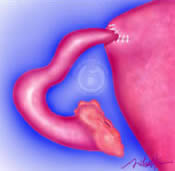
Implantation of the fallopian tube is inserting the tube through a new opening into the uterus. Tubouterine implantation is correct medical terminology, but it is also called tubal implantation, uterotubal implantation, or uterine implantation.

Most tubal ligation operations leave two fallopian tube segments that can be reconnected. In some cases, only one tubal segment remains that is separated from the uterus and the portion of the tube within the uterine muscle is blocked as well. This is most likely to occur when a tubal ligation has been performed by monopolar tubal coagulation applied to the tubal segment next to the uterus. In this situation, tubal implantation is required as the tubal reversal procedure.

How I Perform Tubal Implantation

Dr. Berger performs tubal implantation by making an incision in the uterine muscle and introducing the tube into the uterine cavity.Tubal implantation is performed by making an incision through the uterine muscle. The incision is carried down into the uterine cavity. The tubal segment that has been separated from the uterus is opened and passed down until its proximal end is inside the uterine cavity. Before implanting the tube in the uterus, a suture is placed through the open end that goes inside the uterus. This suture is used to anchor the fallopian tube within the uterine cavity.

The fallopian tube is sutured in the uterine cavity and the uterine incision is sewn together around the implanted tube.When the tube has been anchored inside the uterine cavity, sutures are placed in the uterine muscle around the implanted tube. Care must be taken to close the uterine incision sufficiently to allow healing, but not so tightly that it compresses or constricts the implanted tube. Tubal implantation is a more difficult operation to perform than tubal anastomosis. Tubal implantation accounts for 1% of tubal reversal procedures at Chapel Hill Tubal Reversal Center.

Essure Tubal Sterilization

Thursday, November 29th, 2007

What is Essure?

Essure is a mechanical device that blocks the fallopian tube at the uterus.Essure is a permanent birth control device that has recently become available as an alternative to traditional tubal ligation methods. The spring-like device is inserted through the uterine cavity into the tubal openings using a hysteroscope. This can be done as an in-office procedure. The device expands to fill the tubal opening and then becomes scarred into place, forming a barrier so that sperm cannot reach the egg. Because of the scar formation, it cannot be pulled out of the tube. It is advertised by the manufacturer as a permanent method of birth control. In this respect, it is similar to other tubal ligation methods that are considered by most doctors to be permanent.

Here is a link to an online video animation of the placement of the Essure device into the fallopian tubes.

Is Tubal Reversal Possible For The Essure Device?

I perform 4 tubal reversal procedures each day at Chapel Hill Tubal Reversal Center. The women who come here have all varieties of tubal ligation methods. Today, one of the patients had the Essure sterilization method. When she chose this form of tubal sterilization, she was unaware that she would become remarried and want to be able to try to have a child with her new husband.

Inserting the fallopian tube into a new opening in the uterus is called tubouterine implantation.Although I could not find any previous references regarding attempts to reverse the Essure procedure, I agreed to attempt to perform a reversal for her. The way I did this was to cut the device out of the uterine muscle and then implant the remaining fallopian tube into the uterine cavity through a new opening in the uterus. This procedure is called tubouterine implantation.

The reason I removed the device was that part of the metal spring projects into the uterine cavity. If a pregnancy were to occur with the device in place, this could be harmful to the pregnancy. To my knowledge, this is the first time that the Essure sterilization procedure has been reversed.

Call (919) 968-4656 To Speak With a Tubal Reversal Nurse

Pregnancy Announcements | Daily News | Latest Additions | Press | MD News | Site Map | Español
Website updated May 16th, 2008 Chapel Hill Tubal Reversal Center© Chapel Hill Tubal Reversal Center
109 Conner Drive Suite 2200, Chapel Hill, NC 27514 (919) 968-4656
   Tubal Reversal News ?>
109 Conner Drive Suite 2200, Chapel Hill, NC 27514 (919) 968-4656
