








The fallopian tube is an amazing and versatile reproductive organ.
Its functions include capturing an egg from the ovary at the time of ovulation; nourishing the fertilized egg or zygote during its early cell divisions; and delivering the blastocyst into the uterine cavity when it is time for implantation.
The different parts of the fallopian tube correspond to these various functions.
Tubal Anatomy
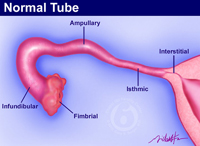 The end of the tube furthest from the uterus is the fimbria.
The fimbrial segment is lush with cilia that beat vigorously and sweep the egg into the tube where it is fertilized.
The egg is quickly moved by the bell-shaped infundibular segment into the ampullary region of the tube.
Over the next several days, the combination of muscular contractions and ciliary movement move the egg toward the uterus.
The ampulla provides nourishing fluid that allows repeated cell divisions.
When the dividing egg (zygote) reaches the stage where the outer membrane dissolves (blastocyst), it is time to be delivered into the uterine cavity.
This is the function of the muscular isthmic segment of tube closest to the uterus.
Does Anatomy Predict Function After Tubal Reversal?
Given the complexity of the functions of the fallopian tube, one might wonder if any portion is essential for pregnancy to occur.
Years ago, based on the information available in medical texts, we assumed that there would be essential parts or a minimum length of tube needed to result in a normal pregnancy. However, there was little information available to answer this question.
Therefore, we began recording the portions of tube removed, tubal segment lengths remaining, and other details about each patient’s reversal operation in an electronic database. Since the staff members at A Personal Choice follow-up with patients regarding pregnancy after tubal reversal, it has become possible to study the interaction of tubal anatomy and the tube’s ability to function normally.
A Surprising Discovery
 Over the 30+ years that we have been performing tubal reversal procedures (Dr Berger, Dr Monteith, Dr Harris), we have seen every variation of tubal ligation imaginable regarding the sections of tubes removed and lengths of tube remaining to repair.
It was surprising to learn that no specific part of the fallopian tube is absolutely required for pregnancy to occur.
Somehow, the fallopian is able to compensate for the loss of specific parts and still function normally!
Based on this knowledge, we are optimistic in being able to repair any kind of tubal sterilization procedure with the expectation that it will allow the possibility of having more children.
Tubal Reversal Surgery
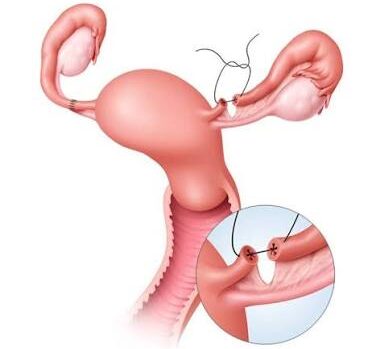 Tubal reversal surgery involves re-connecting the two healthy ends of the tube back together after a prior procedure was done to obstruct this passageway.
This could be by removing clips or rings, and the damage the pinching caused to the tube.
This could be by excising the burned or coagulated portion of the tubes.
This could be by reconnecting previously cut tubes.
This could be by removing Essure or Adiana, followed by re-implantation of the healthy portion of the tubes back into the uterus.
This could be recreating an opening in the end of tube after the fimbria had been previously excised by fimbriectomy.
Wow, that is a lot of ways one could have their “tubes tied”!!!
Predictors Of Success
In the end, restoring tubal normal anatomy is the goal, and this leads to success.
There are some factors that do affect degrees of success:
*- One factor often discussed is tubal length.
The fallopian tube is the passageway from the ovary to the uterus. The egg, as it is ovulated or released from the ovary, must find its way into the opening of the tube and then travel down its length to the uterus.
The tube can usually reach the ovary just fine, unless it is really short.
 Think about baseball. A tall outfielder can really stretch and reach those fly balls to make the catch. A short one would have more trouble, although still would make some catches, just not as high of a percentage.
There is no absolute cut-off for how much tube is needed to be restored to ensure success at future pregnancy, but a good target to have is 4 cm.
- Our studies show an average success rate of tubal reversal surgery to be 67%
- In those same studies, we saw the rates as 62% when tubal lengths were 2.5 – 4.9 cm,
- … and 73% when the tubes were 5 – 7.4 cm,
- … and even 83% when greater than 7.5cm!
- And for those < 2.5 cm after repair, the success rates were at 44%.
Other fertility study groups, including Fertility & Sterility, and Human Reproductive Updates, suggest tubal length plus/minus 4 cm is less a factor for predicting success, as compared to age and tubal type, but would favor IVF over tubal reversal surgery if the predicted lengths were this small (< 4 cm).
Of course, most of the time we cannot know the tubal lengths until the time of surgery. At A Personal Choice, once in surgery we will always repair the tubes unless they are less than 2 cm at that time.
**- Another factor relates to type of tubal ligation procedure
 Some tubal procedures create shorter tubes than others
- Salpingectomy involves cutting some of the tube, and that “some” depends on the doctor of the day operating on ones tubes. Some remove a little, some remove a lot, some remove the entire tube!
- Burning, or coagulation, or cautery, involves burning some of the tube, and that “some” is also dependent on the surgeon. They rarely can burn the entire tube, however, but every cm counts!
- Clips and rings minimally pinch and occlude the tube, usually leaving many centimeters for repair.
- Essure leaves long tubes to re-implant into the uterus.
Having access to operative and pathology records from the prior tubal ligation procedure helps to predict and analyze the reversal procedure and its prognosis for success.
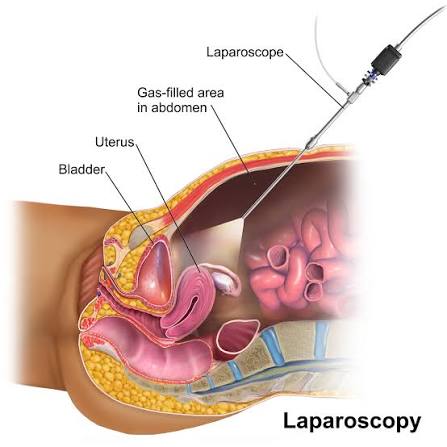 Also, screening laparoscopy can be done to assess the tubal lengths prior to proceeding with the larger incision and reversal surgery.
If you would like more information, including cost of surgery and how to schedule, then you should visit Dr. Harris’ comprehensive website for more information
Dr. Harris’ tubal reversal website: A Personal Choice Tubal Reversal Raleigh NC
If you would like to speak to a staff person then you are encouraged to call (919) 977-5050 to speak with a knowledgeable staff member.