







Chapel Hill Tubal Reversal Center
109 Conner Drive Suite 2200, Chapel Hill, NC 27514 (919) 968-4656

Posts Tagged ‘fallopian tube’

Untying Tied Tubes: Filshie Clip Sterilization

Saturday, May 10th, 2008

Tying Tubes is Not Like Tying a Shoe Lace

Tied tubes are not like a tied shoe lace.Many patients seem to imagine the fallopian tube is like a shoe lace which is tied up like a bow to prevent pregnancy. As tubal ligation reversal specialists, we wish it were that easy- then untying tied tubes would be easier!

‘Tying fallopian tubes’ is a common language phrase used to describe several different surgical procedures that result in tubal sterilization (a procedure intended to permanently prevent pregnancy). The more correct medical term is bilateral (both sides) tubal occlusion (closure of the fallopian tube).

Tubal Ligation Methods

There are many different ways to occlude (close) the fallopian tubes: ligation and resection (tying and cutting), clips and rings, and coagulation (burning). No matter how the procedure is done the end result causes the tube to close, heal shut, and prevent sperm from fertilizing an egg.

Filshie Clip Tubal Ligation

One common form of laparoscopic (camera) sterilization is the use of Filshie clips to occlude both fallopian tubes. The Filshie clip was approved for use in the United States in the mid 1990’s. The Filshie clip is a small titanium clip which is lined with a thin silicone cushion. The clip was an improvement over the Yoon Falope Ring and the Hulka Clip because it was as easy to apply with less risk of operative complications. The clip also has the advantage of destroying only a very small portion of the fallopian tube- approximately 4mm (approximately the thickness of two quarters stacked on each other). The adjacent tube is not affected. The majority of Filshie clips placed in the United States are done by laparoscopic surgery; however, there is a growing trend to use them for tubal occlusion at the time of cesarean delivery (c-section).

Filshie clip applied to the fallopian tube.The Filshie clip causes bilateral tubal occlusion by squeezing a very small portion of the tube. The squeezed portion is deprived of its blood supply and eventually undergoes avascular necrosis (dies and is absorbed by the body). This causes the fallopian tube to be divided in half and the two ends to close up. The Filshie clip is held in place (in between the two divided ends) by a small amount of scar tissue which forms over the clip.

A common misconception is that the Filshie clips can simply be removed to reverse the sterilization process- that the tubes can be unclipped. Unfortunately, tubal ligation reversal for Filshie clips is not as simple as just opening the clips. Filshie clip tubal occlusion is reversed by removing the clips and using microsurgical techniques to open the closed ends and join the tubal segments back together in perfect alignment.

The reversal of Filshie clip tubal occlusion is usually technically easier than some other methods of sterilization because such a minimal amount of tube is destroyed in the occlusion process.

Approximately 76% of patients at Chapel Hill Tubal Reversal Center become pregnant after a reversal of a Filshie clip sterilization procedure.

Tubal Sterilization Can Be Reversed

Many people believe tubal sterilization is permanent and irreversible. Although Filshie clip sterilization is intended to be permanent, this procedure can be reversed. Chapel Hill Tubal Reversal Center is the one medical facility that specializes in tubal ligation reversal.

We have become experts in reversing all types of tubal ligations- or ‘untying’ tubes that have been ‘tied’!

Submitted by Dr. Charles Monteith

Untying Tied Tubes

Thursday, May 1st, 2008

Tying Tubes

A simple lace tie. Many people seem to imagine the fallopian tube is like a shoe lace that is tied in a bow to prevent pregnancy. As a tubal ligation reversal specialist, I wish it were that simple- then reversing tied tubes would be a whole lot easier!

Perhaps a well meaning doctor may have told a patient one day, “I am going to tie your tubes so you don’t get pregnant.” Maybe the doctor wrote a letter to a medical journal explaining the procedure and then the terminology stuck. More likely, a reporter may have simplified the terminology for the surgical procedure of tubal ligation to make a catchy title for an article. Others may then have started using the term “tying tubes” to quickly explain a complex procedure. These explanations often have a long life span and make their way into common language.

The more accurate terminology is bilateral tubal occlusion (closure of both fallopian tubes) which results in sterilization (not being able to conceive). There are many ways to perform bilateral tubal occlusion. The most common tubal sterilization procedure is performed at the time of cesearean delivery (c-section) or immediately after having a baby. It does involve tying the tubes with a suture - but then also cutting out a segment of healthy tube, resulting in closure of the tube as it heals. The suture then dissolves. The intial suture tying is most likely where the phrase ‘tying tubes’ came from.

Another common method is to burn the tubes with electrical energy (electrocoagulation). This is usually done by laparoscopic surgery and is usually done remote from pregnancy. Lastly, there are many devices- clips and bands - which can close off the tubes and cause a portion of the tube to be destroyed.

No matter how the procedure is done, the end result is obstruction of the fallopian tube that prevents pregnancy.

Many people believe that tubal sterilization is irreversible. Although bilateral tubal occlusion is intended to be permanent, the procedure can be reversed. Chapel Hill Tubal Reversal Center is the one medical facility that specializes exclusively in reversal of tubal ligation. We have become tubal ligation reversal experts………experts at untying tied tubes!

Submitted by Dr. Charles Monteith

Ectopic Pregnancy and Tubal Rupture After Tubal Reversal

Sunday, January 6th, 2008

I recently received an email from a patient who had an ectopic pregnancy subsequent to her tubal reversal. Unfortunately, the pregnancy continued to the point of tubal rupture with the loss of the fallopian tube.

Patient’s History

I was hoping you could help me understand why my ectopic pregnancy was not detected early enough to prevent the loss of my right tube. I need to know this for the future as after my surgery I have only my left tube remaining.

I went to my doctor at approximately 3 weeks pregnant and made sure that they understood the importance of checking for ectopic pregnancy. I gave them a copy of your instructions and told them my goal is to prevent losing my tube if it is ectopic, so I told them to please check and make sure it is not ectopic. They did blood work 3 times and did a vaginal ultrasound at approximately 4 weeks and said everything was normal and the sac was in the uterus, not the tube. They did not check anything again until I spotted Tuesday of this week. I went in Wednesday and they did a vaginal ultrasound and said it was ectopic with a heartbeat and I needed surgery and my tube would have to be removed.

My tube was removed because it was starting to rupture. I never expected that to happen because I took the precautions necessary.

Can you please tell me what normal pregnancy hormone levels are for each week of pregnancy versus ectopic hormone levels?

When is an ectopic visible on ultrasound? Could this have been prevented? Was there anything else that could have been done?

Role of Serum HCG in Early Pregnancy Monitoring

HCG levels alone do not differentiate between uterine and ectopic pregnancy. The HCG levels provide the earliest evidence of whether implantation has occurred successfully (but not where it has occurred) and indicate when ultrasound examination should be able to find a gestation sac if the pregnancy is in the uterine cavity. This occurs when serum HCG reaches 1500-2000 mIU/dL. If serum HCG levels are rising too slowly, or if ultrasound does not find a gestation sac in the uterus when HCG is at the level of 1500-2000, then the pregnancy is not a normal one. It could be outside of the uterus (ectopic) or it could be an abnormal pregnancy in the uterus (blighted ovum).

Role of Transvaginal Ultrasound

A careful transvaginal ultrasound exam can detect a normally developing pregnancy in the uterus very early. It is apparent in this case that the initial ultrasound findings were not interpreted correctly. How could this occur?

The intrauterine gestation sac has a white ring or halo around a dark center as seen with ultrasound examination..An intrauterine gestation sac is a dark oval shaped area of fluid surrounded by a bright white ring or halo (the trophoblastic tissue). Probably in this case there was a small amount of fluid in the uterine cavity that was mistakenly thought to be a gestation sac. This has been described as a “pseudo-sac”. A pseudo-sac does not have the distinct white halo or ring of a true gestation sac.

Gestation sac and yolk sac seen in early pregnancy by ultrasound examination.In a normally developing uterine pregnancy, a follow-up ultrasound exam will show the presence of a yolk sac (the small circle within the gestation sac) within a week of the appearance of the gestation sac. If the initial ultrasound exam had been followed-up with another ultrasound scan, it would have shown that this was not a normal uterine pregnancy.

Comment

There is an increased risk of ectopic pregnancy following tubal reversal surgery. Our follow-up pregnancy statistics show that the risk of ectopic pregnancy remains constant with each pregnancy. In other words, it is the same for a first, second, third, or subsequent pregnancy after tubal reversal surgery. It is important, therefore, to monitor any pregnancy after tubal reversal early and closely.

Recommendations for early pregnancy monitoring are given on our website page entitled I’m Pregnant. Although the recomended tests were performed, the most critical one - the ultrasound exam to document the location of the gestation sac - was interpreted erroneously.

An experienced ultrasonographer should be able to differentiate between a true gestation sac and a pseudo-sac by the presence or absence of the bright halo surrounding the fluid filled sac. If there is any doubt, a repeat ultrasound exam looking for the appearance of a yolk sac should be performed.

Although ectopic pregnancy is not preventable, the complication of tubal rupture always should be. In the absence of clear ultrasound evidence of an intrauterine pregnancy, early treatment with Methotrexate is recommended. It is important to monitor serum HCG levels until the HCG level returns to less than 10 mIU/dL. This will prevent a possible ectopic pregnancy from advancing to the complication of tubal rupture.

Tubal Reversal by Tubouterine Anastomosis

Saturday, December 22nd, 2007

Tubal Anastomosis at the Uterine Cornua

The uterine cornua is the area where the fallopian tube emerges from the uterus.Tubouterine anastomosis is a tubal reversal procedure that is intermediate between tubotubal anastomosis and tubouterine implantation. It is also called cornual anastomosis because the tube is joined to the cornual area of the uterus with this operation. The cornu is the area where the fallopian tube normally emerges from the the uterus.

When Is Tubouterine Anastomosis Performed?

Tubouterine anastomosis attaches a healthy segment of fallopian tube to the cornual area of the uterus.Tubouterine anastomosis is performed when there is a healthy tubal segment near the ovary, but no segment remains attached to the uterus, following a tubal ligation procedure. It is also performed when a tubal segment attached to the uterus is scarred and has no open lumen.

An incision is made into the uterus at the cornu to find the opening of the fallopian tube tube as it passes through the uterine muscle. If an opening is found, the tubal segment that remains is rejoined to the uterus at this site.

Case Histories

The topic of tubouterine anastomosis is a timely one. During the past week, 2 patients undergoing tubal reversal surgery at Chapel Hill Tubal Reversal Center required this operative procedure. In one case, each fallopian tube had been coagulated or burned next to the uterine cornu, leaving no segment attached to the uterus. The other patient had developed the condition known as salpingitis isthmica nodosa in the portion of the fallopian tube between the uterus and the a Falope ring. In both cases, tubal reversal was able to performed with the technique of tubouterine anastomosis.

Dr. Berger’s Comment

Frequently, patients have been informed by doctors who are not specialists in tubal ligation reversal that their fallopian tubes cannot be repaired after a tubal ligation. This is especially true when the proximal segments of the fallopian tubes are missing or diseased. But there are a variety of surgical techniques that can be used during tubal reversal surgery by a doctor who is an experienced tubal reversal surgeon. This is one of the advantages patients have when they come to Chapel Hill Tubal Reversal Center for their tubal reversal procedures.

Unusual Tubal Abnormalities at Tubal Reversal Surgery

Monday, December 17th, 2007

Salpingitis Isthmica Nodosa

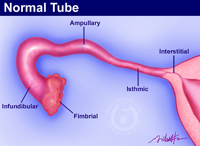
Salpingitis isthmica nodosa is a tubal abnormality sometimes found at tubal reversal surgery.Salpingitis isthmica nodosa is a nodular swelling of the isthmic segment of the fallopian tube. This fallopian tube abnormality is sometimes encountered at the time of tubal reversal surgery. It often involves the interstitial portion of tube that is within the uterine muscle. The nodule is due to thickening of the muscular wall of the tube around ingrowths or projections of the inner mucus membrane tubal layer into the muscle.

History of Salpingitis Isthmica Nodosa: Scholarly Publications

This tubal abnormality was first described and named by Chiari in 1887 .(1) The name he gave it reflected his belief this was an inflammatory condition. (Salpingitis means inflammation of the fallopian tube.) His contemporary, Kossman, also thought this was an inflammatory condition.(2) An alternate theory of causation was suggested by Recklinghausen in 1896 who believed it to be a congenital abnormality.(3) A third possibility, suggested by Benjamin and Beaver in 1951, is that SIN is an acquired, noninflammatory condition.(4) They believed that the lesion begins as an overgrowth of the inner tubal lining that penetrates into the tubal muscular wall. Then cysts form and the tubal muscular wall becomes enlarged and fibrotic. This has also been termed endosalpingosis, a condition closely related to uterine adenomyosis (a form of endometriosis in which the uterine endometrium grows into the uterine muscle).

HSG Diagnostic Findings

Hysterosalpingogram (HSG) diagnostic of salpingitis-isthmica-nodosa.Salpingitis isthmica nodosa can be diagnosed radiographically. A hysterosalpingogram or HSG shows multiple small diverticuli or outpouchings of of x-ray dye protruding from the tubal lumen into the wall of the isthmic portion of the fallopian tubes. Because of its appearance at HSG, radiologists call it tubal diverticulosis.(5)

Clinical Implications

Salpingitis isthmica nodosa is associated with increased rates of infertility by interfering with upward sperm migration and ectopic pregnancy by trapping the fertilized egg within the tube.

Treatment During Tubal Reversal

Salpingitis isthmica nodosa may be encountered at the time of tubal reversal surgery. Because of the dense abnormality of the fallopian tube at its connection with the uterus, tubotubal anastomosis is not possible. In this situation, tubouterine anastomosis or tubouterine implantation can be performed.

History of Tubal Reversal Surgery

Sunday, December 16th, 2007

Tubal Reversal Scholarly Publications

Early Experimental Studies in Animals

History of tubal reversal surgery - early experimental studies cited by Dr. Berger.In 1969, David, Brackett and Garcia (1) reported using microsurgical techniques for uterotubal anastomosis after removing the uterotubal junction from one side in 25 rabbits. Among 11 (44%) of the animals that became pregnant, fewer implantations occurred on the operated side than on the unoperated side. This showed that the uterotubal junction has a role, but is not absolutely required, in transferring embryos from the fallopian tube into the uterus for implantation.

In 1974, Paterson and Wood (2) divided the isthmic segment of one fallopian tube and then performed tubal anastomosis in 10 rabbits. They removed the fallopian tube and ovary on the other side so that any pregnancies that followed could be attributed to the repaired fallopian tube. The pregnancy rate was 60%. These investigators suggested that tubal anastomosis could be applied successfully to humans for reversal of tubal sterilization.

Hulka and Ulberg (3) in 1975 were the first to perform a successful reversal of tubal sterilization under experimental conditions. Six weeks after applying Hulka clips to the isthmic portion of fallopian tubes in 8 pigs, they removed the clipped portion of tubes and performed tubal anastomosis using an absorbable, multifilament suture (6-0 Dexon). Six (75%) of the animals subsequently became pregnant.

In 1975 Winston (4) reported an experiment in rabbits in which the experimental variables were different suture materials and duration of tubal splinting. In one group of 25 rabbits, he removed a portion of the tubal isthmus or ampulla and then performed tubotubal anastomosis with a nonabsorbable, nonreactive, monofilament suture (10-0 nylon). Using microsurgical technique, Winston took special care to include only the 2 outer layers (muscularis and serosa) of the fallopian tube in the suture line, avoiding the inner tubal layer (endothelium). He stabilized the anastomotic sites with polyethylene splints that were removed before closure of the abdominal cavity. Twenty-three (92%) of the animals became pregnant. This was the highest pregnancy rate reported so far after tubal anastomosis in animal studies. When either 8-0 catgut was used as the suture material or the tubal splint was left in place for 1 week after surgery, the pregnancy rate dropped in half.

Winston’s results were subsequently corroborated using microsurgical tubal anastomosis with 11-0 nylon, intraoperative splinting, and avoiding mucosal trauma from suture in the reconstruction of rabbit oviducts six weeks after application of Falope rings. Eighteen (82%) of 22 rabbits became pregnant after two matings.

Comment

Experimental studies in animals demonstrated excellent pregnancy rates following reconstruction of the fallopian tube by tubal anastomosis. They provided the basis for tubal reversal surgery as a clinical treatment. The best results came using microsurgical techniques with non-reactive, monofilament suture material, intraoperative tubal splints, and avoiding the introduction of suture in the inner layer of the tube.

Dr. Berger uses these surgical techniques in his tubal reversal procedures. For a more complete description of the early history of tubal reversal surgery, read Dr. Berger’s book chapter, Reversal of Female Sterilization: An Evaluation of Results (5).

References

  1. David A, Brackett BG, Garcia CR: Effects of microsurgical removal of the rabbit uterotubal junction. Fertil Steril 20:250, 1969
  2. Hulka JF, Ulberg LC: Reversibility of clip sterilization. Fertil Steril 26:1132, 1975
  3. Paterson P, Wood C: The use of microsurgery in the reanastomosis of the rabbit fallopian tube. Fertil Steril 25:757, 1974
  4. Winston RML: Microsurgical reanastomosis of the rabbit oviduct and its functional and pathological sequelae. Br I Obstet Gynaecol 82 :513, 1975
  5. Berger GS: Reversal of female sterilization: An evaluation of results. In JM Phillips, editor, Microsurgery in Gynecology, Chapter 33. American Association of Gynecologic Laparoscopists, Downey, California, 238-243, 1977.

Laparoscopy Before Tubal Ligation Reversal

Friday, December 14th, 2007

Tubal Ligation Operations Vary

Tubal ligation operations vary in the amount of damage they cause to the fallopian tubes. Tubal coagulation (cauterization) tends to damage more of the tube than tubal ligation and resection or tubal clips/rings. Burning or cauterizing the fallopian tubes with a monopolar coagulator is more destructive than with a bipolar coagulator. With either type of coagulator, the more times the tube is burned, the greater the amount of damage that occurs.

How Much Fallopian Tube Remains After a Tubal Ligation?

The remaining amount and condition of the fallopian tubes after tubal ligation procedures varies a great deal. A patient’s tubal ligation operative report will give an indication about the remaining tubal segments that can be repaired by a tubal reversal procedure. When available, Dr. Berger always reviews the operative reports that are sent by patients to estimate the likely outcome from a tubal reversal operation.

In most cases, the tubal ligation operative report (and a pathology report if available) will help to determine if tubal reversal is possible. Until the time of surgery, the actual condition of the fallopian tubes remains unknown. This is partly because doctors differ in how they perform tubal ligation operations. With tubal coagulation procedures, for example, the coagulator can be used at different power settings and applied for varying lengths of time to the fallopian tubes. These details usually are not specified in an operative report.

Examining the Fallopian Tubes by Laparoscopy

Laparoscopy can be performed before tubal reversal to assess the condition of the fallopian tubes. Laparoscopy is a surgical procedure that permits viewing the fallopian tubes through a narrow telescope placed through a small incision below the belly button into the abdominal cavity. Laparoscopy can be performed for patients who want to be assured that tubal reversal is possible.

Laparoscopy is recommended in cases where the amount of tube remaining is questionable, such as after monopolar coagulation of multiple sites along the fallopian tube.

Dr. Berger performs laparoscopy under anesthesia and proceeds directly to tubal reversal, if examination shows the tubes are repairable. The patient is under anesthesia only one time. For safety reasons, screening laparoscopy is offered only to patients with a body mass index (BMI) of less than 30.

Screening Laparoscopy Cost

The additional charge for laparoscopy is $1000. If tubal reversal is not possible, the operation will end and you will receive a refund of close to 50% of the total surgery fee. The screening laparoscopy option is similar to an insurance policy. You purchase it and hope you never need it, but it is certainly nice if you do. Most patients do not elect to have the laparoscopic examination because of its additional cost and the knowledge that Dr. Berger can repair the fallopian tubes in 98% of cases, regardless of the method of tubal ligation.

Tubal Reversal By Tubal Implantation

Monday, December 3rd, 2007

Tubal Reversal Procedures

There are 3 types of tubal reversal procedures:

  • anastomosis
  • implantation - (this blog topic)
  • salpingostomy

Implantation of Fallopian Tubes

Implantation of the fallopian tube is inserting the tube through a new opening into the uterus. Tubouterine implantation is correct medical terminology, but it is also called tubal implantation, uterotubal implantation, or uterine implantation.

Most tubal ligation operations leave two fallopian tube segments that can be reconnected. In some cases, only one tubal segment remains that is separated from the uterus and the portion of the tube within the uterine muscle is blocked as well. This is most likely to occur when a tubal ligation has been performed by monopolar tubal coagulation applied to the tubal segment next to the uterus. In this situation, tubal implantation is required as the tubal reversal procedure.

How I Perform Tubal Implantation

Dr. Berger performs tubal implantation by making an incision in the uterine muscle and introducing the tube into the uterine cavity.Tubal implantation is performed by making an incision through the uterine muscle. The incision is carried down into the uterine cavity. The tubal segment that has been separated from the uterus is opened and passed down until its proximal end is inside the uterine cavity. Before implanting the tube in the uterus, a suture is placed through the open end that goes inside the uterus. This suture is used to anchor the fallopian tube within the uterine cavity.

The fallopian tube is sutured in the uterine cavity and the uterine incision is sewn together around the implanted tube.When the tube has been anchored inside the uterine cavity, sutures are placed in the uterine muscle around the implanted tube. Care must be taken to close the uterine incision sufficiently to allow healing, but not so tightly that it compresses or constricts the implanted tube. Tubal implantation is a more difficult operation to perform than tubal anastomosis. Tubal implantation accounts for 1% of tubal reversal procedures at Chapel Hill Tubal Reversal Center.

Tubal Reversal by Tubal Anastomosis

Sunday, December 2nd, 2007

Tubal Reversal Procedures

There are 3 types of tubal reversal procedures:

  • anastomosis - (today’s blog topic)
  • implantation
  • salpingostomy

Anastomosis of Fallopian Tubes

Anastomosis connects two body parts. Tubotubal anastomosis is connecting two segments of the fallopian tube. Tubotubal anastomosis is correct medical terminology, but it is also called tubal anastomosis for short. Bilateral tubal anastomosis means that both tubes are repaired by the anastomosis technique. The anastomosis sites can be specified for each fallopian tube. They may be different for the two sides. For example, a patient may have a right isthmic-ampullary tubotubal anastomosis and a left ampullary-ampullary tubal anastomosis. Sometimes, only one fallopian tube is repairable with the anastomosis technique. This is called unilateral tubotubal anastomosis.

Bilateral Tubal Anastomosis

Most tubal ligation operations separate the fallopian tube into two segments. Bilateral tubotubal anastomosis, therefore, is the most common tubal reversal procedure. Bilateral tubal anastomosis accounts for 90% of the tubal reversal procedures at Chapel Hill Tubal Reversal Center.

How I Perform Tubal Anastomosis

Dr. Berger performs tubal anastomosis by placing a stent in the tubal lumen bringing the 2 segments of fallopian tube together.After opening the blocked ends of the two tubal segments, I pass a flexible stent or thread through the tubal lumen or opening of the two segments until it reaches the uterine cavity. This ensures that the fallopian tube is open from the uterine cavity to its fimbrial end and that the tubal segments align properly. A suture placed in the connective tissue, just beneath the fallopian tube segments, draws the tubal segments together.

The fallopian tube segments are sewn together with microsurgical sutures and the tubal stent is removed.The muscular and outer layers of the tubal segments are connected with microsurgical sutures. Care is taken to avoid suturing the inner layer of the fallopian tube. Suture material is a foreign body. Stitches placed in the inner tubal lining can cause scarring inside the tubal lumen. When the two tubal segments are joined together, the stent is withdrawn from the fimbrial end of the tube.

Watch The Operation

The images above illustrate the principles of tubotubal anastomosis. For more details, you can watch the operation as it is being performed. A short video clip online gives an overview. If you want to watch the entire tubal anastomosis procedure, you can order a videotape or dvd of Tubal Ligation Reversal by Dr. Berger as shown on TV by the Discovery and Learning Channels. Watching the full length video will help you better understand how I perform tubotubal anastomosis as outpatient tubal reversal surgery.

Tubal Reversal After Tubal Coagulation (Burned Tubes)

Friday, November 30th, 2007

Tubal Ligation by Coagulation or Cauterization

Bipolar tubal coagulation usually damages a small amount of fallopian tube and is an excellent tubal ligation method for tubal reversal.Bipolar tubal coagulation is a popular method of female sterilization in the United States. This tubal ligation method is usually performed through laparoscopy. With the bipolar (two-poles) coagulator, the fallopian tube is grasped between two poles of electrical conducting forceps and electrical current is passed through the tube between the two ends of the forceps. Damage to the tube is limited mainly to the small segment between the forceps. Burning two or three adjacent sites is common and generally results in the loss of a few centimeters of the fallopian tube. Bipolar tubal cauterization can be successfully reversed in almost all cases.

Monopolar tubal coagulation is a tubal ligation method that results in moderate pregnancy rates after tubal reversal surgery.Monopolar tubal coagulation is less common than bipolar coagulation tubal ligation. With monopolar forceps, electrical current spreads further along the length of the fallopian tube. Consequently, monopolar cautery tends to damage more of the fallopian tube than bipolar cautery. In many cases, the tube is also cut after it has been coagulated.

When monopolar coagulation is applied to a single site of the tube, tubal reversal can be performed without the need for further diagnostic tests. If multiple sites of the fallopian tube have been burned with the monopolar technique, we offer a screening diagnostic laparoscopy to evaluate the tubal lengths before proceeding to reparative surgery. The screening laparoscopy option is discussed further on our website.

Tubal Coagulation Reversal Success

Each year Chapel Hill Tubal Reversal Center publishes updated statistics about pregnancy rates and pregnancy outcomes among all of the women who have had tubal reversal procedures performed by Dr. Berger. The data for women who had tubal coagulation sterilizations, presented in the table below, are from our Tubal Reversal Pregnancy Study Report 2007.

Pregnancy Rates of Our Tubal Reversal Patients

The overall pregnancy rate after tubal reversal for women with tubal coagulation procedures is 68% for patients at Chapel Hill Tubal Reversal Center. To calculate the pregnancy rate, the number of women who have become pregnant is divided by the total number who underwent a tubal reversal procedure. The following table shows the numbers and pregnancy rates according to womens’ ages at the time of their tubal reversal surgery.

Pregnancy Rates After Tubal Coagulation Reversal


Age


All Women


Pregnant (#)


Pregnant (
%)

<30

168

142

85%

30-34

482

357

74%

35-39

408

260

64%

40+

130

46

35%

Conclusion

Tubal coagulation methods of tubal ligation can be successfully reversed in most cases. The pregnancy rate after tubal reversal varies with a woman’s age at the time she has her tubal reversal procedure. The pregnancy rate is 85% for women in their twenties, 74% for those ages 30-34, 64% for women in the 35-39 year age group, and 35% for women 40 years of age or older.


Special Report


Answers to seven important questions to find out if tubal reversal is right for you.

Request this Special Report:


Call 919 968-4656 to speak with a Tubal Reversal Nurse.

Call (919) 968-4656 To Speak With a Tubal Reversal Nurse

Pregnancy Announcements | Daily News | Latest Additions | Press | MD News | Site Map | Español
Website updated May 12th, 2008 Chapel Hill Tubal Reversal Center© Chapel Hill Tubal Reversal Center
109 Conner Drive Suite 2200, Chapel Hill, NC 27514 (919) 968-4656
   Tubal Reversal News ?>
109 Conner Drive Suite 2200, Chapel Hill, NC 27514 (919) 968-4656