






Chapel Hill Tubal Reversal Center
109 Conner Drive Suite 2200, Chapel Hill, NC 27514 (919) 968-4656

Tubal Reversal Blog ‘salpingitis isthmica nodosa’

IVF Alternative | Tubal Surgery

December 31st, 2008

Chapel Hill Tubal Reversal center offers surgical procedures to correct tubal ligation (tubal ligation reversal) and both blocked and damaged fallopian tubes.Chapel Hill Tubal Reversal Center offers an excellent  alternative to in vitro fertilization (IVF) – namely, tubal surgery to untie tubes and correct tubal blockage. If you have had your fallopian tubes tied (tubal ligation) or have blocked tubes and want to become pregnant, then tubal surgery may be the best treatment for you.

Read the rest of this article and comment on it. »

Difficult Tubal Reversal Situations

May 20th, 2008

How Important Is a Tubal Reversal Doctor’s Experience?

Julia Smith, RN Nurse AdministratorOf the many questions I receive daily from potential patients, one of the most important questions is what makes Dr. Berger the best choice to perform tubal reversal vs. another doctor. With a specialized procedure such as tubal ligation reversal, surgical experience is the most important factor in predicting success from the operation. Dr. Berger has performed more than 7000 tubal reversal operations and has the most experience of any tubal surgeon in the world.

Tubal Repairs That Other Doctors Could Not Perform

We routinely hear from women who have gone to a nearby doctor for a tubal reversal, only to have the doctor stop the procedure before repairing the tubes because an unexpected situation was encountered during surgery. There are multiple situations where this may happen:

The fallopian tube.1. No isthmic tubal segment remains and tubouterine implantation needs to be performed.

There are few, if any, other doctors who can perform this type of operation and none could do so as outpatient surgery. At Chapel Hill Tubal Reversal Center, Dr. Berger has successfully performed this type of operation many times as a safe and effective outpatient operation.

2. A fimbriectomy has been performed.

Tubal ligation by fimbriectomy involves removing a portion (usually up to one-third) of the fallopian tube closest to the ovary. To our knowledge there are no other doctors performing fimbriectomy reversals. The pregnancy rate following fimbriectomy reversal performed by Dr. Berger is 56%.

3. The patient has only a proximal tubal segment (attached to the uterus) on one side and a distal tubal segment (near the ovary) on the other side.

This is an unusual situation, but Dr. Berger has successfully attached these two segments on opposite sides of the body to create one tube with 2/3 women becoming pregnant afterwards. This operation has not been described in the medical literature. Dr. Berger calls this operation “contralateral tubotubal anastomosis”.

4. The patient is found at the time of surgery to have inherent disease of the fallopian tubes due to tubal endometriosis, salpingitis isthmica nodosa, or pelvic inflammatory disease. In these situations, Dr. Berger removes the diseased tubal segment and repairs the fallopian tube with the most appropriate reversal operation.

Experience Is The Most Important Consideration

Experience is the most important indicator of whether successful tubal reversal surgery can be performed when a woman has a difficult tubal reversal situation due to short tubes, missing tubal segments, fimbriectomy, or inherent diseases of the tubes. While most doctors would be unwilling – or unable – to perform a reversal procedure in one of these situations, Dr. Gary Berger is able to repair the tubes in 98% of cases, regardless of the type of sterilization that has been performed or whether difficult situations are encountered.

Submitted by Julia Smith, R.N.
Nurse Administrator

If you have questions or would like assistance scheduling your surgery, please contact me.

JuliaS@tubal-reversal.net
(919) 656-8204

Unusual Tubal Abnormalities at Tubal Reversal Surgery

December 17th, 2007

Salpingitis Isthmica Nodosa
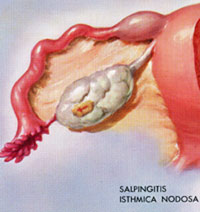
Salpingitis isthmica nodosa is a tubal abnormality sometimes found at tubal reversal surgery.Salpingitis isthmica nodosa is a nodular swelling of the isthmic segment of the fallopian tube. This fallopian tube abnormality is sometimes encountered at the time of tubal reversal surgery. It often involves the interstitial portion of tube that is within the uterine muscle. The nodule is due to thickening of the muscular wall of the tube around ingrowths or projections of the inner mucus membrane tubal layer into the muscle.

History of Salpingitis Isthmica Nodosa: Scholarly Publications

This tubal abnormality was first described and named by Chiari in 1887 .(1) The name he gave it reflected his belief this was an inflammatory condition. (Salpingitis means inflammation of the fallopian tube.) His contemporary, Kossman, also thought this was an inflammatory condition.(2) An alternate theory of causation was suggested by Recklinghausen in 1896 who believed it to be a congenital abnormality.(3) A third possibility, suggested by Benjamin and Beaver in 1951, is that SIN is an acquired, noninflammatory condition.(4) They believed that the lesion begins as an overgrowth of the inner tubal lining that penetrates into the tubal muscular wall. Then cysts form and the tubal muscular wall becomes enlarged and fibrotic. This has also been termed endosalpingosis, a condition closely related to uterine adenomyosis (a form of endometriosis in which the uterine endometrium grows into the uterine muscle).

HSG Diagnostic Findings

Hysterosalpingogram (HSG) diagnostic of salpingitis-isthmica-nodosa.Salpingitis isthmica nodosa can be diagnosed radiographically. A hysterosalpingogram or HSG shows multiple small diverticuli or outpouchings of of x-ray dye protruding from the tubal lumen into the wall of the isthmic portion of the fallopian tubes. Because of its appearance at HSG, radiologists call it tubal diverticulosis.(5)

Clinical Implications

Salpingitis isthmica nodosa is associated with increased rates of infertility by interfering with upward sperm migration and ectopic pregnancy by trapping the fertilized egg within the tube.

Treatment During Tubal Reversal

Salpingitis isthmica nodosa may be encountered at the time of tubal reversal surgery. Because of the dense abnormality of the fallopian tube at its connection with the uterus, tubotubal anastomosis is not possible. In this situation, tubouterine anastomosis or tubouterine implantation can be performed.

More information on » salpingitis isthmica nodosa

Special Report

Answers to seven important questions to find out if tubal reversal is right for you.

Telephone 919 968-4656 to speak with a Tubal Ligation Reversal Nurse

Call a Tubal Reversal Nurse
for a free consultation -

(919) 968-4656

Pregnancy Announcements | Latest Additions | FAQs | Press | MD News | Mission Statement | Privacy Policy | Doctors Directory | Site Map


http://www.tubal-reversal.net/includes/footer.php  was last modified on November 1st, 2009 18:15:35

Chapel Hill Tubal Reversal Center.
109 Conner Drive Suite 2200, Chapel Hill, NC 27514
Tel: (919) 968-4656     Fax: (919) 869-1976
